
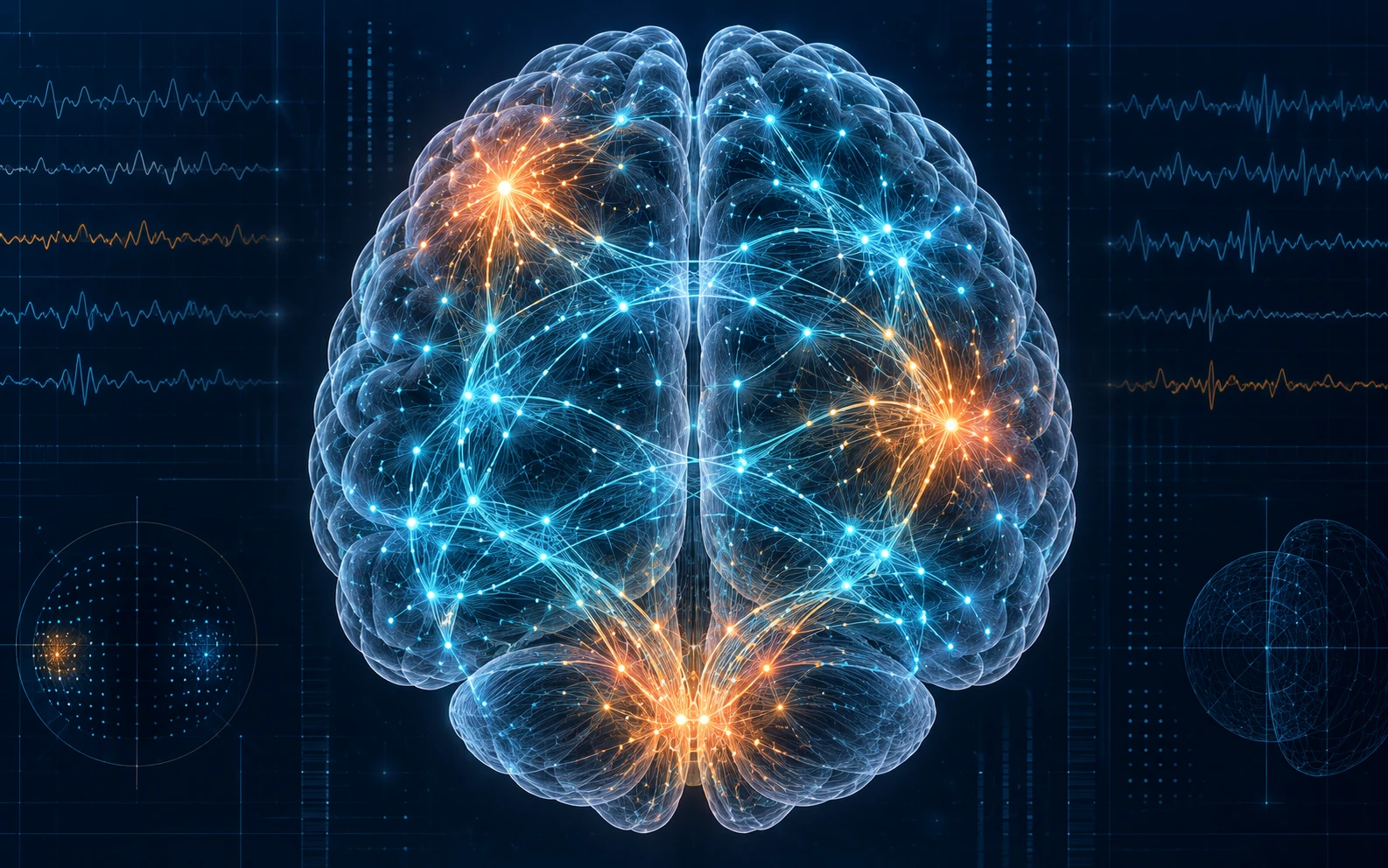
What happens when researchers train one brain rhythm and track both memory and EEG changes?
The training approach
Eleven people with mild cognitive impairment completed ten 30-minute neurofeedback sessions over five weeks. Training targeted individual upper-alpha activity over a central parietal region. Researchers assessed cognition and EEG before training, afterward, and 30 days later.
Two different timelines
Peak alpha frequency increased with the number of training sessions, and memory performance improved significantly. Memory gains remained at follow-up even though peak alpha frequency had returned to baseline. That distinction matters: a cognitive change and an EEG change do not necessarily follow the same timeline.
An early signal worth studying
This open-label pilot provided a reason to investigate further. Without a comparison group, it cannot separate training effects from expectations, repeat testing, or other influences. It does not establish that neurofeedback prevents dementia.
Lavy Y, Dwolatzky T, Kaplan Z, Guez J, Todder D. Neurofeedback Improves Memory and Peak Alpha Frequency in Individuals with Mild Cognitive Impairment. Appl Psychophysiol Biofeedback. 2019;44:41–49. doi:10.1007/s10484-018-9418-0.
Read the original research →